


A long distance move in Canada usually costs several thousand dollars, and the final figure depends mostly on three things: how much you move (weight or volume), how far it travels, and when you go. One 2026 estimate puts a cross-Canada two-bedroom move at C$7,000 to C$12,000 with full-service movers. A shorter interprovincial move costs less. The only number that matters for your budget is a written estimate based on what a mover has actually seen in your home.
Below you’ll find the typical ranges, what the bill is made of, the extras that catch people out, and how to cut the total without risking your belongings.
TL;DR
- Long distance moves are priced mainly on shipment weight or volume and the distance between your two addresses, so the size of your home and how much you keep drive the cost more than anything else.
- Published ranges for a cross-Canada two-bedroom move run from about C$2,000 for a self-move truck to C$12,000 for full service. The cheapest option is not always the cheapest once fuel, hotels and your time are counted.
- Extras such as packing, storage, stairs, long carries and insurance can add meaningfully to the total, so ask for them to be itemized.
- Get the estimate in writing, signed, after the mover has seen everything you are moving. Federal guidance says an advance payment should not normally exceed the estimate by more than 10%.
- Moving outside peak summer months can lower the price.
Table of Contents
- What a long distance move costs in Canada
- How movers calculate the price
- What is usually the most expensive part
- Extras that raise the bill
- Estimate checklist: what a reliable written quote includes
- How to lower the cost of a long distance move
- Movers, containers, freight or a rental truck
- Get a written estimate from Ferguson
- Worked example: how one estimate might be built
- Moving to Canada or across several provinces
- FAQ
- Sources
What a long distance move costs in Canada
There is no single national price, because a move from Calgary to Edmonton and a move from Halifax to Vancouver are very different jobs. Think in tiers by distance and home size.
The ranges below are planning figures drawn from published 2026 estimates. They are not Ferguson prices, and they are a starting point for questions, not a quote.
| Move type | Typical planning range | What drives it |
|---|---|---|
| Cross-Canada, 2-bedroom, full-service movers | C$7,000 to C$12,000 | Weight, 4,000+ km, crew time |
| Cross-Canada, 2-bedroom, portable container | C$4,000 to C$7,000 | Container count, you load and unload |
| Cross-Canada, 2-bedroom, freight shipping | C$2,500 to C$5,000 | Shared truck space, flexible delivery window |
| Cross-Canada, 2-bedroom, rental truck | C$2,000 to C$4,500 | Fuel, hotels, your own labour |
| Toronto to Vancouver, 3-bedroom or larger, movers | Over C$14,000 on one 2026 route table | Heaviest, longest conventional route |
Two things to notice. First, the spread inside each row is wide, which is normal: a two-bedroom home with a few boxes and a two-bedroom home with a piano, a workshop and a full garage are not the same shipment. Second, the cheapest rows hand work and risk back to you.
How movers calculate the price
For local moves, the bill is usually hourly. For long distance, it changes. Distances beyond roughly 150 km are generally priced on the weight of the shipment and the distance travelled, and CAA-Quebec notes that for moves over 50 km a mover will often want to assess the volume in person. It adds that billed kilometres and travel time are generally measured between your two addresses, not from the moving company’s warehouse.
In practice, a long distance estimate has these building blocks:
- Shipment size. The cubic feet or weight of everything on the truck. This is the biggest lever you control.
- Distance and route. More kilometres means more fuel, driver time and truck time. Remote destinations and mountain or winter routes cost more to serve.
- Labour. Loading, unloading and, if you want it, packing.
- Materials. Boxes, wrap, wardrobe cartons, mattress covers, specialty crates.
- Insurance and liability coverage. What protection is included and what you can add.
- Timing. Peak season, month-end and weekends are in demand.
- Extras. Access problems, storage, shuttle trucks and anything not on the original inventory.
This is why a price quoted over the phone from “two bedrooms, about 4,000 km” is a guess. Weight is the real input, and a mover can only estimate it by seeing your belongings.
What is usually the most expensive part
For most households the biggest line is the transport and labour tied to the weight of the shipment. Packing is the next big discretionary item, and storage is the surprise one when move-out and move-in dates do not line up.
What that means for you: the quickest way to lower the bill is to lower the weight. Every piece of furniture you sell, donate or leave behind comes off the truck. A heavy, low-value item, such as an old sectional or a mattress you’d replace anyway, can cost more to ship than to replace.
Extras that raise the bill
Most surprises come from details nobody asked about at quote time. Raise each of these early.
Packing and materials
Full packing means a crew wraps and boxes your home. It saves days of your time and, in our experience, reduces damage risk because trained packers do it every week. If you would rather pack yourself, you can buy boxes and supplies from our moving supplies page. Ferguson also offers packing services if you want to hand over all of it, or just the kitchen, artwork and other fragile rooms.

One published 2026 guide suggests budgeting roughly C$500 to C$2,000 for packing materials and service, depending on home size. Treat it as a ballpark and ask for packing to be shown as its own line.
Storage gaps
If you leave one home before the next is ready, your belongings need somewhere to stay. Short-term storage is often priced monthly, and the same guide puts it at around C$300 to C$400 a month for short stays. Tell your mover your realistic dates, since a delayed possession date is one of the most common ways a budget slips. Our storage services can hold a shipment between homes.
Access: stairs, elevators, long carries
Condo moves can mean booked elevators, loading dock rules and parking permits. If the truck cannot park near the door, a long carry fee may apply, and one guide cites C$75 to C$200 as a typical range. Mention every flight of stairs, narrow hallway and shared driveway at both ends.
Vehicles and special items
Shipping a car typically adds a separate transport charge, and the same source lists about C$1,200 to C$2,500 per vehicle depending on route. Pianos, safes, hot tubs, gun safes and large artwork also need special handling, so list them on the first call.
Items added on moving day
This is the classic trap. The Office of Consumer Affairs advises that you make sure the mover sees all your items and that you ask about additional costs if items are added on moving day. A garage full of things nobody mentioned can change the weight, and the price with it.
Your own travel
If you are not driving a rental truck, you still pay to get yourself and your family there. For a cross-country trip, plan flights or fuel, and consider temporary accommodation between homes if your belongings arrive after you do.
Estimate checklist: what a reliable written quote includes
A good estimate is boring and specific. The Office of Consumer Affairs says to get the quote in writing on company letterhead, signed by a representative, and that it should include the number of boxes, the size and value of items, the cost, payment terms and the time of services.
Use this list when you compare:
- The mover looked at your belongings, in person or on a live video walkthrough, rather than quoting from a room count.
- The quote is written, signed and names the company.
- The inventory, packing, labour, transport and insurance are separate lines.
- Access conditions at both addresses are written down.
- Payment terms are stated. In most situations the advance payment should not exceed the estimate by more than 10%, so ask how the mover handles that.
- Delivery window is stated, and so is what happens if it slips.
Be cautious of a quote that arrives with no questions asked or a price far below every other one. We cover the warning signs in our guide to avoiding long distance moving scams.
How to lower the cost of a long distance move
Move less
Start with a purge six to eight weeks out. Sell or donate furniture that is cheap to replace, and skip heavy items such as old exercise equipment. Fewer cubic feet means a smaller quote, every time.
Pick your timing
Summer is the busiest season. One 2026 source says that winter moves between November and March are typically 20 to 30% cheaper than summer. Treat that as a general pattern, since weather and routes matter. If your dates are flexible, ask for quotes for a few different weeks. Our article on why winter moving can save money goes through the trade-offs, and so does our piece on winter moving scams in Toronto.
Pack some of it yourself
Packing books, linens and off-season clothes yourself is the easiest saving. Leave fragile and high-value items, and anything awkward, to professionals. Our long distance moving checklist lays out the timeline.
Be flexible with delivery
Movers that consolidate shipments can sometimes offer a wider delivery window. If you can live without your things for a few days, ask whether a window changes the price.
Check whether the move is tax-deductible
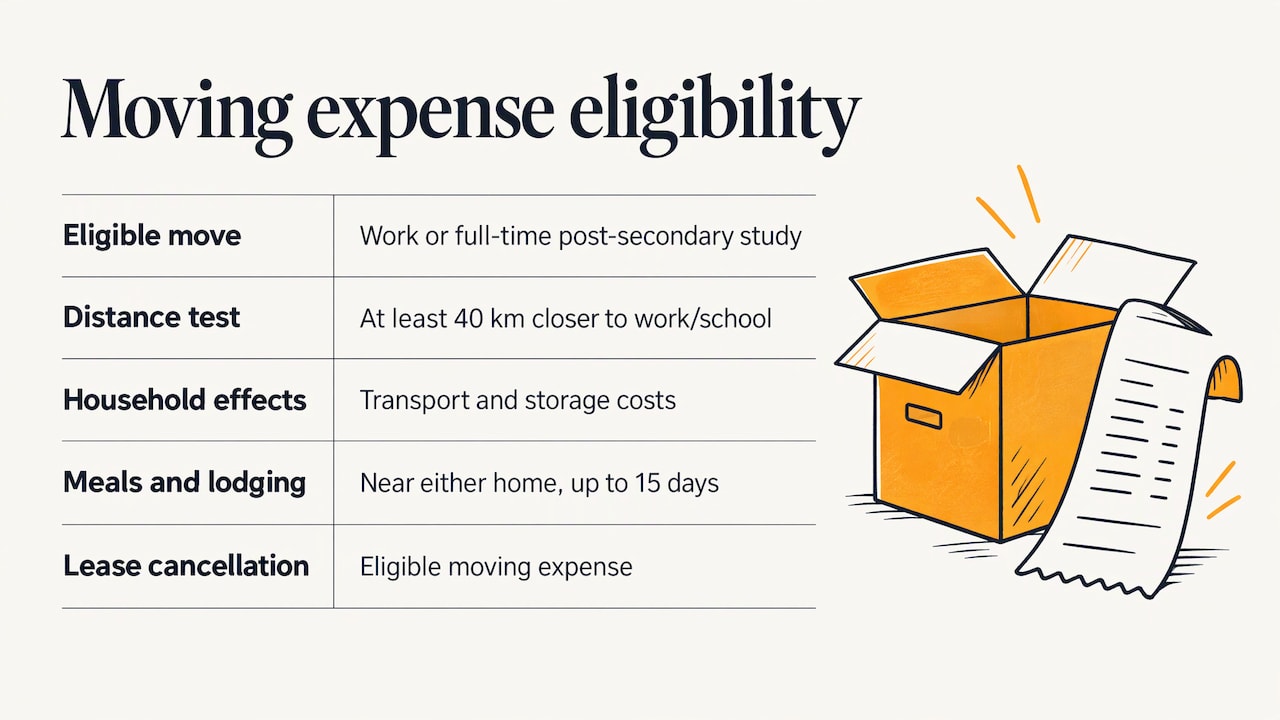
If you are moving for work or full-time post-secondary study, you may be able to claim moving expenses. The Canada Revenue Agency says your new home must be at least 40 kilometres closer to the new work or school than your old one. Eligible expenses include transporting and storing household effects, travel costs, and meals and lodging near the old or new home for up to 15 days, as well as lease cancellation costs. Keep every receipt and check the rules with a tax professional for your own situation.
Movers, containers, freight or a rental truck
The right choice depends on how much you value your time and how much you are moving.
| Option | Price level | You do | Best for |
|---|---|---|---|
| Full-service movers | Highest | Little: movers pack, load, drive, unload | Whole-home moves, families, seniors, tight timelines |
| Portable container | Middle | Load and unload yourself | Flexible timing, moderate volume |
| Freight or shared truck | Lower | Load and unload, accept a delivery window | Small shipments, flexible dates |
| Rental truck | Lowest on paper | Everything, including the driving | Small homes, strong helpers, short cross-province trips |
With a self-move, the sticker price is not the whole cost. One source lists fuel at C$600 to C$1,200 for a cross-country drive, plus three to five nights of accommodation at C$100 to C$150 a night, along with meals and the physical toll of driving 4,000+ km. Add the damage risk to your own furniture and the days you are not working, and the gap with a full-service move narrows quickly.
Our view: certainty is the real cost saver
Most people compare long distance quotes by the bottom line. We think the more useful comparison is how firm the number is. A low estimate that can climb on moving day is not a low price.
That is why we give a written estimate before any packing starts, and why we do the first assessment by video consultation. You walk your phone through the home, we see the furniture, the garage and the awkward stairs, and we can usually give you a tailored quote within 20 minutes. Because we have seen what is actually going on the truck, the quote reflects it.
Our crews are trained, and on moving day you can follow the move with GPS tracking, which matters on a trip of several days. We have been moving Canadians since 1916, and what we have learned is simple: people forgive a price they understood, and they do not forgive one that changed.
Ask every mover what happens if the shipment turns out heavier than estimated. We’ll answer that question in writing.
Lorne
Get a written estimate from Ferguson
If you are planning a long distance move, we can give you a written estimate before packing starts, based on a video walkthrough of your home. Ferguson handles local, long distance and international residential moves, as well as packing and storage, and we also work with businesses through commercial moving.

Book a video consultation through our residential moving page and have your inventory, both addresses and your target dates to hand. We serve Vancouver, Victoria, Toronto and Calgary, and moves between them are a regular part of our work. Heading east? Our guide to long distance moving to Toronto covers planning from the other end.
Worked example: how one estimate might be built
The figures below are illustrative to show the logic, not a Ferguson price. Imagine a household moving a two-bedroom apartment from Toronto to Calgary.
- Inventory. Sofa, bed, dresser, table with four chairs, 40 boxes, a bike. The mover sees it all on video and estimates the shipment weight.
- Transport. Priced on that weight and the distance between the two addresses.
- Packing. The household packs books and clothes, and asks the mover to pack kitchen and fragile items.
- Access. Third-floor walk-up at origin, elevator booking at destination. Both are written into the estimate.
- Storage. Possession in Calgary is two weeks after move-out, so two weeks of storage is added.
- Insurance. Coverage level confirmed in writing.
Now change one thing: the household finds a second storage unit’s worth of things in the garage a week before the move. The weight goes up, and the estimate has to be updated. That is the point of an itemized estimate: the price moves for a reason you can see, rather than appearing on moving day.
Moving to Canada or across several provinces
If you are arriving from abroad, the long distance leg can start at a port or a border, and customs paperwork adds steps. Our guide to international moving to Canada walks through what to expect. If you are selling a home as part of the move, our article on saving money on real estate services can help you trim costs on the other side of the transaction.
FAQ
How much does a long distance move cost in Canada?
It depends on weight, distance and season. One 2026 estimate for a cross-Canada two-bedroom move with full-service movers is C$7,000 to C$12,000, and shorter interprovincial moves cost less. Only a written estimate based on an assessment of your belongings gives you a figure you can budget with.
What is the cheapest way to move between provinces?
On paper, a rental truck or freight shipping, depending on how much you are moving. Once you count fuel, accommodation, meals, your time and the risk of damage, a full-service move can be closer than it first looks. Compare the total cost of each option, not the headline.
Is it cheaper to move yourself?
Sometimes, for a small home and a shorter route. For a cross-country move the savings shrink because of fuel and several nights of accommodation. Heavy furniture and long driving days are where self-moves go wrong.
Can the price change after I sign?
It can if the shipment changes, for example if items are added on moving day. That is why the Office of Consumer Affairs recommends a signed written quote and asking about extra costs in advance. With a firm written estimate and an accurate inventory, surprises are much less likely.
When is the best time to book a long distance move?
Book several weeks ahead, and consider moving outside the summer rush. Winter dates are often cheaper, though weather and routes are factors for the mover to plan around.
Sources
- Moving advice, Office of Consumer Affairs
- A successful move: Guide and key steps, CAA-Quebec
- Income Tax Folio S1-F3-C4, Moving Expenses, Canada.ca
- Cross-Canada Moving Cost 2026, MovingCalculator
- Average Long-Distance Moving Costs from Toronto in 2026