

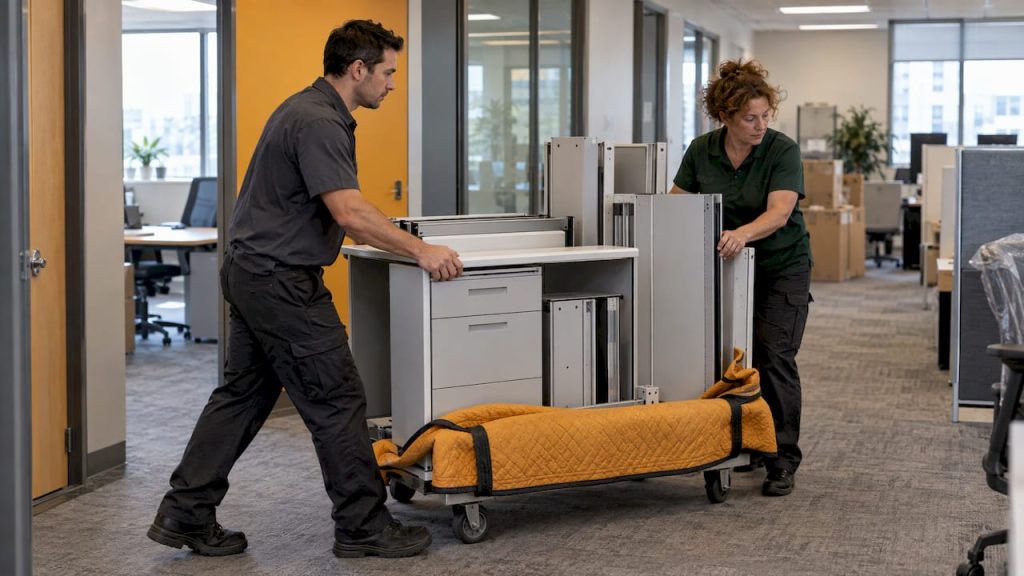
Corporate movers handle the physical side of a business move: packing, transporting and setting up offices, equipment and, in some cases, employees’ household goods. Corporate relocation is a wider job that can also cover housing, tax and policy support. Most Canadian organizations need one or both, and deciding which early saves the most money and stress. This guide explains the difference, what to arrange, how to plan, and how to pick a mover you can trust.
TL;DR
- An office move and an employee relocation are different jobs. Decide early whether you need a physical mover, a relocation manager, or both.
- Start planning 6 to 9 months ahead where you can, and hold a 10 to 15% budget contingency.
- Choose a mover on commercial experience, comparable references, a written scope and estimate, and a site visit or detailed consultation.
- If you are moving staff to another city, check their contracts first: an unagreed change of work location can amount to constructive dismissal.
- Ferguson Moving & Storage guarantees a written price before packing begins and offers a video consultation for a tailored quote.
Table of Contents
- What corporate movers actually do
- Services a company can arrange
- How to plan a corporate move, step by step
- What drives the cost of a corporate move
- How to choose a corporate mover
- Moving employees: the legal points to check first
- Keeping the business running during the move
- Planning a business move? Start with a written price
- FAQ
- Sources
What corporate movers actually do
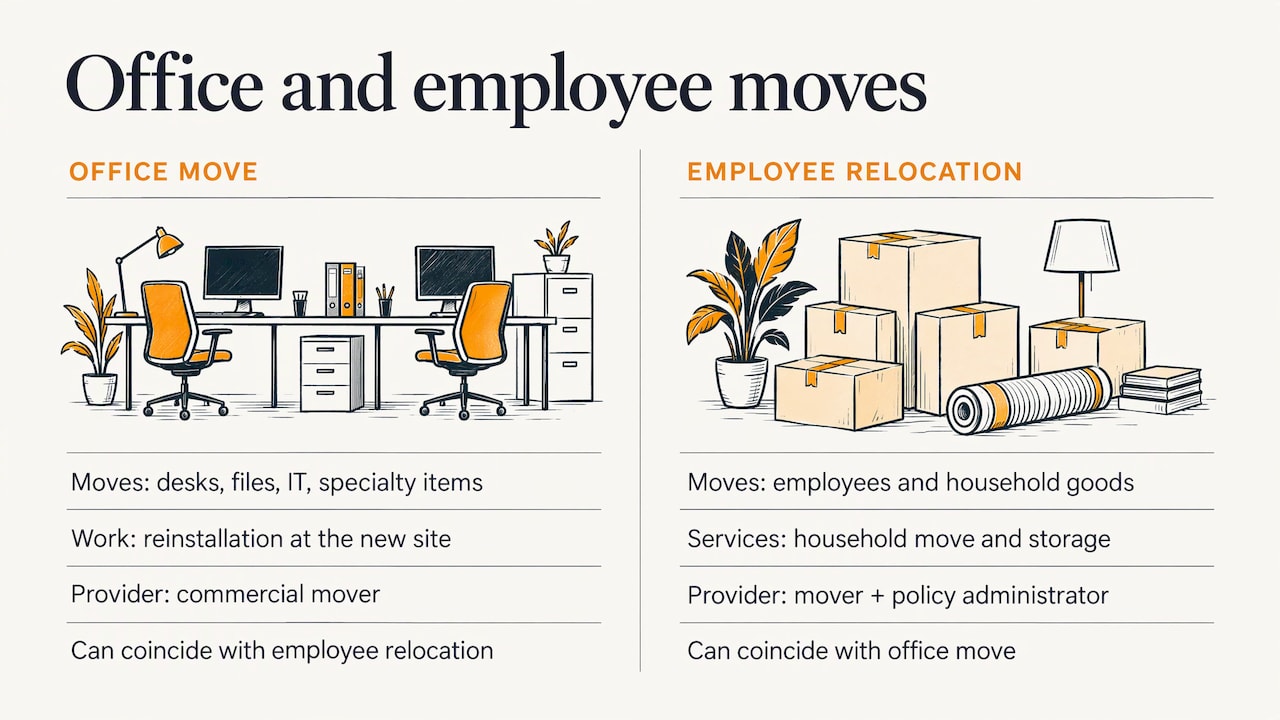
The phrase covers two services that often get mixed up.
Commercial or office moving is the move of a workplace from one location to another: desks, workstations, files, IT equipment, specialty items, and the reinstallation at the new site. A mover that does this well works alongside your IT team, electricians, building management and security.
Corporate relocation moves people. It covers employees and their belongings going to new homes, sometimes in another province or country. A moving company generally focuses on packing, transporting, unloading and sometimes storing household goods, while a relocation-management company may also administer policy, expenses, housing and tax support.
Both can happen at once. A company opening a second office might move its premises and send ten employees across the country in the same quarter. The practical point: pick the scope first, then pick providers. If you only need the trucks, crews and packing, a commercial mover is the right partner. If you need housing searches and expense administration for transferees, you will add a relocation-management layer on top.
Ferguson Moving & Storage has been moving Canadians since 1916 and serves both residential and commercial clients. On the commercial side that includes office moving, corporate relocation, film industry moving, contractors and builders, final mile delivery, restoration moving and commercial storage. You can see the full list on our commercial moving page.
Services a company can arrange
The menu is wider than “a truck and some boxes.” Here is how it breaks down.
For an office or facility move
- Site assessment and a written scope of work
- Packing of files, supplies and equipment, with labelled crates or cartons
- Disassembly and reassembly of workstations
- Handling of specialty items such as servers, lab equipment or art
- After-hours or weekend work to protect trading time
- Short- or long-term storage for furniture and equipment between sites
- Delivery and placement at the new premises
For employee relocations
Domestic relocation programs can include policy consultation, pre-move counselling, home-sale or purchase support, household-goods management, temporary housing, destination services, expense management and family support. International moves add customs coordination, import and export paperwork, and transport by sea, air and road. Not every business needs all of this. Many small and mid-sized employers offer a simpler package: a lump sum or a paid household move, with the employer choosing the mover.
When the household move is the main item, a full-service mover with local, long-distance and international capability covers it. Our residential moving services include local, long-distance and international moves, condo and apartment moves, and seniors moving, plus packing services and storage when a transferee’s home sale and new home do not line up.
How to plan a corporate move, step by step
The Canadian Association of Movers (CAM) names late planning, incomplete scope, underestimated costs and poor coordination among movers, IT, electricians, building management and security as the usual risks in commercial moves. Nearly all of them are solved by planning earlier and writing things down.
- Set the timeline. One Canadian move-management guide recommends kicking off planning 6 to 9 months before the target move date, with a 15% time buffer and a 10% budget buffer for roadblocks. For a small office, a shorter runway can work, but the same order of tasks applies.
- Define the scope. List what moves, what is replaced, what goes to storage, and what is disposed of. Count workstations, meeting rooms, special equipment and anything that needs crating.
- Assign owners. Name one internal lead, plus owners for IT, facilities, HR and finance. CAM notes that successful commercial moves share open communication, clearly defined responsibilities and a shared plan understood by internal teams and outside vendors.
- Book a site assessment. Have your mover walk the old and new sites, or do a video walkthrough. Check elevators, loading docks, building move-in hours and parking permits.
- Get the estimate in writing. It should name labour, packing, specialty handling, storage and after-hours work separately.
- Communicate with staff. Tell people what is happening, when, and what they need to do with their own desks.
- Run the move day. Confirm crew arrival, building access and the order in which areas are packed and unpacked.
- Follow up. Keep a post-move support period for missing items, IT issues and damage reports.
For more office-specific tactics, our guide with 7 tips for moving offices goes deeper, and if your customers find you online, read how to preserve your SEO when moving your business. Retailers will also want our notes on relocating a retail shop.
What drives the cost of a corporate move
Corporate moves are quoted to the job, not to a rate card, because no two offices are alike. The factors that move the number most are:
- Volume and complexity: workstation count, specialty items, and how much is packed by the mover versus your staff.
- Distance: local, long-distance across provinces, or international.
- Access: floors, elevators, loading dock availability, and building rules on move-in hours.
- Timing: after-hours and weekend work, and peak seasons.
- Storage: time between leaving the old site and moving into the new one.
- Extras: equipment rental, hook-up charges, temporary services and repairs.
CAM recommends a comprehensive commercial-move budget that covers labour, storage, equipment rental, hook-up charges, temporary services and potential repairs, with a typical 10 to 15% contingency reserve. Build the contingency into the budget you take to your finance team, not into the quote you ask a mover for.
We do not publish set prices for commercial work, because an honest price needs the details of your move. What we do commit to is a guaranteed written price before packing begins, so the number you approve is the number you plan around.
Our view: the estimate is where a move is won or lost
We have been moving people and businesses across Canada since 1916, and the pattern is consistent. Moves go wrong when the price and the scope were vague on day one. A company is told one thing on the phone, then finds extra charges once the crew is already on site.
That is why we put the written estimate first. Our approach is a guaranteed, binding written price before any packing starts, built from a conversation about what you actually need moved. For many clients that conversation is a personalized video consultation, and we can give you a tailored quote within 20 minutes of it.
The second piece is the crew. We use trained, in-house crews, and on moving day we provide GPS tracking, so an office manager can see where the truck is without phoning around. For a business, that visibility matters as much as the lifting: staff are waiting on desks, IT is waiting on equipment, and a client may be waiting on a phone line.
The third piece is responsibility. If something is damaged, we want the conversation to be simple and fair. Choose a mover that will put all of this in writing, and hold us to the same standard.
Lorne
How to choose a corporate mover
CAM’s guidance for selecting a commercial mover points to demonstrated commercial and office-relocation experience, comparable client references, a written scope and estimate, and clarity about labour, specialty handling, storage and after-hours work. The same guidance suggests looking at whether the estimate rests on a site visit or thorough consultation, how the mover protects and tracks assets, and how it handles delays and damage claims.
Turn that into a scorecard you can use with every provider on your shortlist:
| Criterion | What good looks like |
|---|---|
| Commercial experience | Recent office or facility moves of similar size |
| References | Clients in your industry or of comparable scale you can call |
| Estimate | In writing, itemized, based on a site visit or detailed video consultation |
| Price certainty | A clear statement on whether the price is binding |
| Crew | Trained crews, not last-minute day labour |
| Tracking | A way to see where your assets are on move day |
| Scheduling | A plan for conflicts, delays and after-hours work |
| Damage | A clear, written process for claims |
| Storage | Available if the old and new leases do not line up |
For a broader checklist that applies to any move, see how to pick the best moving company. If part of your move follows an insurance event such as a fire or flood, note that you may have a say in who does the work: read about choosing your own moving company for insurance claims. Restoration moving is one of the commercial services we offer.
Why not move the office yourselves?
Some teams consider a weekend of staff carrying boxes. The hidden costs are lost productivity, injury risk and damaged equipment. Our comparison of moving yourself versus hiring movers and the case for hiring professional movers lay out the trade-offs. If you move heavy equipment, tools or machinery, our guide on moving tools and heavy equipment covers what to prepare.
Moving employees: the legal points to check first
If your move changes where people work, the employment side needs as much care as the logistics. Speak to an employment lawyer or your HR adviser before announcing anything.
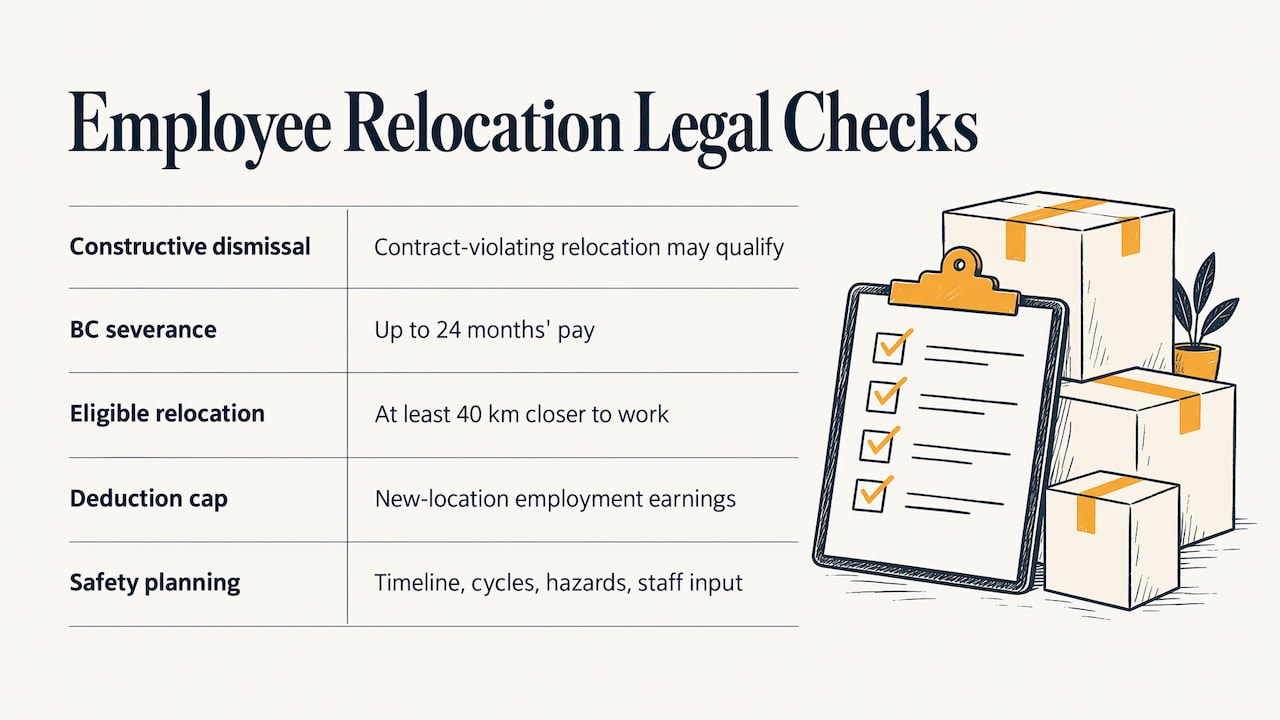
Constructive dismissal. Constructive dismissal happens when fundamental, unfavourable changes to job conditions force an employee out. HR Insider notes that a relocation may constitute constructive dismissal when it violates the terms of the employee’s contract, and that employers can guard against it with contract language that expressly allows transfers to a different location. In British Columbia, one employment law firm explains that a significant, unagreed change to work location may entitle the employee to severance of up to 24 months’ pay. Concern grows when the commute and costs rise substantially, when the employee must move homes, or when the contract does not permit the change.
Moving expense deductions. Under the Income Tax Act, a taxpayer can deduct moving expenses for an eligible relocation, meaning a move that lets them work at a new location and brings them at least 40 kilometres closer to the new work location. The deduction cannot exceed earnings from employment at the new location. Ask your accountant how this applies to each transferee, and how any employer-paid moving costs are treated.
Workplace safety. The Canadian Centre for Occupational Health and Safety (CCOHS) advises that employers establish a timeline of major tasks, communicate clearly with staff, and plan the moving date around business cycles, such as production downtime or a quieter time of year. All staff should also be told about any new safety hazards at the new site and take part in decisions.
Keeping the business running during the move
Disruption is the real cost of an office move, and it is mostly controllable.
- Phase it. Move teams that are less time-sensitive first, and keep customer-facing teams working until the last window. A phased schedule, weekend or overnight windows, a pilot small team to validate layout and IT, and a post-move support desk are commonly recommended practices.
- Label everything by destination. Floor plans at the new site with desk numbers matching the labels on the crates save hours on the day.
- Ask staff to clear their own desks. Personal items and confidential files are best handled by their owners, with the mover packing shared equipment.
- Plan IT separately. Servers, phones and network gear should have their own move sequence and a named person on both sides.
- Book storage for the gap. If the new space is not ready, commercial storage keeps furniture and equipment safe until it is.
- Keep customers informed. Update your address, website, listings and email signatures before the move day, not after.
If your move crosses provinces or the country, our long distance moving checklist is a useful structure to hand to transferees, and if you are moving in the colder months in Alberta, see how to choose a reliable moving company in Calgary this winter.
Planning a business move? Start with a written price
Ferguson Moving & Storage handles office moves, corporate relocations and the household moves that come with them, from our locations in Vancouver, Victoria, Toronto and Calgary. You get a guaranteed written estimate before packing begins, trained crews, and GPS tracking on moving day. Explore our office and corporate moving services, or book a video consultation and have a tailored quote within 20 minutes.

Need boxes, kits or specialty cartons for your own team to pack? Our moving supplies page lists what we carry, and the Ferguson Moving & Storage homepage is the place to start a quote.
FAQ
What is the difference between a corporate mover and a relocation company?
A corporate mover handles the physical move: packing, transport, unloading and setup. A relocation-management company administers the wider program, such as policy, expenses, housing and tax support. Many organizations use a mover alone, and larger programs add a relocation manager on top.
How far ahead should I book a corporate move?
One Canadian move-management guide recommends starting planning 6 to 9 months before the target date. Smaller offices can move faster, but earlier planning gives you better access to weekend and after-hours windows. Book a site assessment as soon as the new location is confirmed.
What should a corporate moving estimate include?
It should be written and itemized, with clarity on labour, packing, specialty handling, storage and after-hours work. Ideally it rests on a site visit or a detailed consultation. At Ferguson, we guarantee a written price before packing begins and offer a video consultation for a tailored quote.
Can an employer require staff to relocate?
Only if the employment contract and the circumstances allow it. A change of work location that the contract does not permit can be treated as constructive dismissal. Speak to an employment lawyer or your HR adviser before you announce a transfer.
Can Ferguson handle both the office and the employees’ household moves?
Yes. We provide office moving and corporate relocation for businesses, plus local, long-distance and international household moves, packing and storage. One provider for both can simplify scheduling and communication.
Sources
- Common Risks in Commercial Moves, Canadian Association of Movers
- How to Choose the Right Commercial Mover for Your Office, Canadian Association of Movers
- Move Management in Canada, Zenith Software
- CCOHS: Office Relocation
- Best Practices for Employee Relocations and Transfers, HR Insider
- Change of Work Location: Employee Rights in BC, Samfiru Tumarkin LLP
- Del Vecchio v. The King, 2023 TCC 46
- Corporate Relocation vs. Moving Company, TRC Global Mobility
- Corporate Domestic Relocation Services, CapRelo
- 10 Essential Steps for a Smooth Office Relocation in 2026, Hughes Marino