

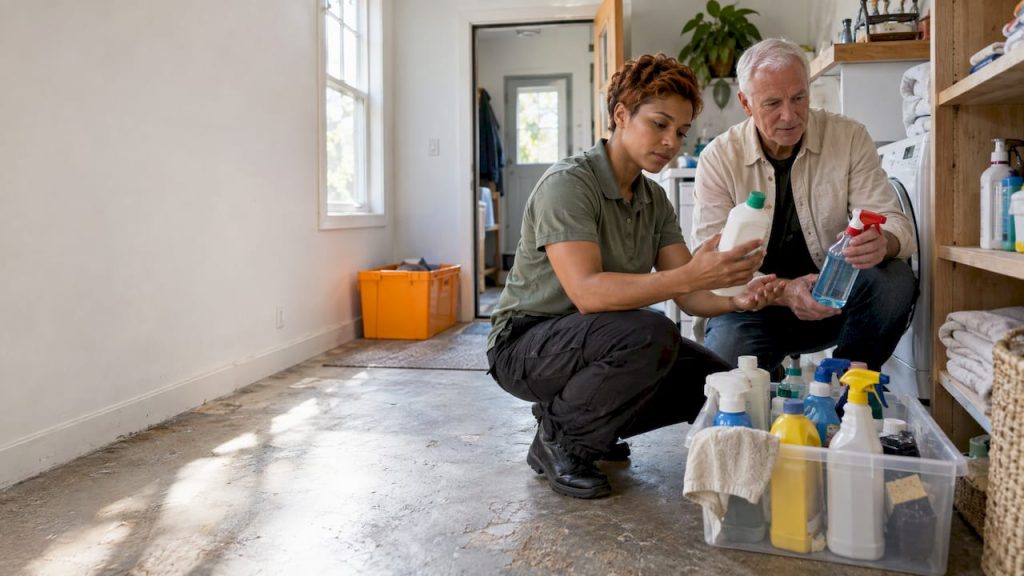
Movers will not load anything dangerous, perishable, alive or irreplaceable onto a truck. That covers flammables, propane tanks, aerosols, food that needs a fridge, pets, ammunition, and cash and papers you cannot replace. The rules protect the crew, your other belongings and your claim if something goes wrong. We run every move with our own employees in our own trucks, so we want you to hear about these items from us before moving day, not on the driveway. Use the lists below to sort your home room by room.
Key Takeaways
- Hazardous goods are the biggest group: fuel, propane, paint, bleach, aerosols, ammunition and fireworks. Canada’s federal relocation rules treat these as items a carrier will not move.
- Food that needs cooling, pets and, in most cases, live plants stay off the truck. A truck cannot hold a steady temperature or care for a living thing.
- Keep documents, jewellery, cash, medication and your phone with you. Mover liability for goods of extraordinary value depends on declaring them.
- Very large items such as hot tubs, boats and trailers need a plan of their own.
- Valuation protection up to $6 per pound is standard on our moves. It is not insurance, and it covers what we load, not what we cannot take.
Table of Contents
- Why movers refuse certain items
- Hazardous items: the list to clear first
- Food, plants and pets
- Firearms and ammunition
- Valuables, papers and things you cannot replace
- Large and awkward items
- What to do with items a mover will not take
- Does everything need to be in a box?
- How we handle moving day
- Moving a home office or a business
- Your move, planned with us
- Our perspective
- FAQ
- Sources
Why movers refuse certain items
Three reasons sit behind almost every refusal.
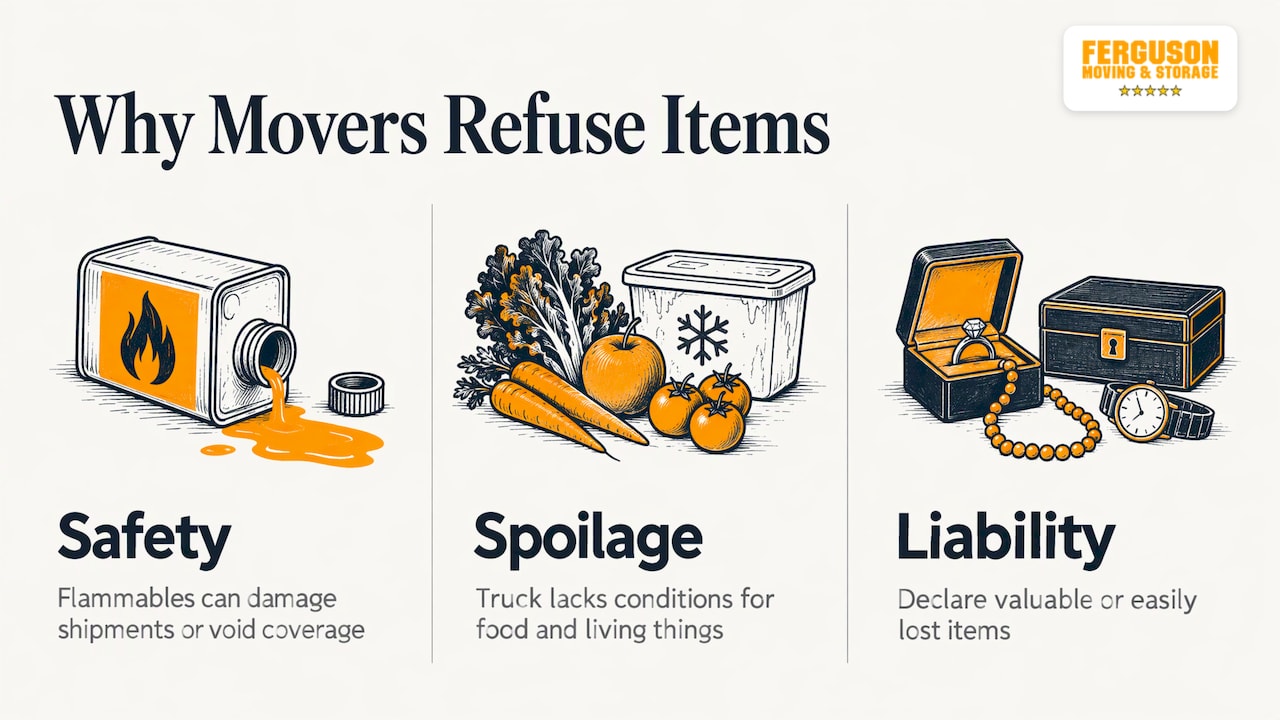
Safety. A truck is a closed space with heat, vibration and sharp stops. A leaking can of solvent or a pressurized cylinder can start a fire or injure the crew. The Canadian Association of Movers (the industry body for the sector) warns that flammables, propane, aerosols and liquid cleaners can damage the shipment and may void coverage if a leak, fire or accident occurs.
Spoilage and care. Fresh food, frozen food and living things need conditions a moving truck cannot provide for hours or days.
Liability. Some items are worth so much, or are so easy to lose, that carriers will not take responsibility for them unless you declare them.
There is also a plain legal point. Dangerous goods are regulated under the federal Transportation of Dangerous Goods Act, and firearms and ammunition are regulated under the Criminal Code of Canada. A mover cannot choose to ignore either.
Hazardous items: the list to clear first
Start in the garage, under the kitchen sink and in the laundry room. These are the places where most refused items hide.
| Item | Examples | Why it stays off the truck |
|---|---|---|
| Fuel and gas | Gasoline, propane tanks, lighter fluid, camp stove fuel | Flammable, and pressure can build in heat |
| Pressurized containers | Aerosol cans, spray paint, fire extinguishers | Can burst or leak |
| Paint and solvents | Paint cans, stain, paint thinner, nail polish remover | Spills can ruin a whole load |
| Cleaning chemicals | Bleach, ammonia, liquid detergent, pool chemicals | Leaks damage other goods and can react together |
| Explosives | Ammunition, fireworks, flares | Fire and explosion risk |
| Corrosives | Acids, car batteries | Burn skin and damage furniture |
| Firewood | Stacked or bagged logs | Can carry pests, and is on the federal inadmissible list |
The federal government’s list of inadmissible items for its own relocations names pressurized containers, fuel, propane tanks, firewood, perishable goods, livestock and pets, ammunition, restricted firearms, and liquids such as paint cans that could cause extensive damage if they rupture. That list is written for government moves, but it matches what the public guidance from the moving industry says.
Batteries and electronics
The small batteries inside your phone, laptop and tablet are a different matter from car batteries. Canada’s Transportation of Dangerous Goods Regulations set conditions for small lithium cells and batteries, including limits on lithium content, protection against damage and short circuits, and packaging and marking. The simple route for you is to keep loose batteries, power banks and chargers with you, and leave the devices themselves in the box for the crew.
Acid car batteries, spare batteries from power tools in bulk, and anything swollen or leaking should not go in the truck at all.
Food, plants and pets
Perishable food
Fresh, refrigerated and frozen food will not travel in a moving truck. The federal list names perishable goods as inadmissible. A mover has no way to keep food cold, and a warm box of spoiled food ruins everything packed beside it.
A good plan for the last two weeks:
- Stop buying fresh groceries and plan meals from the freezer and pantry.
- Donate unopened, non-perishable food to a local food bank.
- Pack the last day’s food and drinks in a cooler that rides in your car.
Opened pantry items such as flour, sugar and spices are a judgment call. Sealed jars and dry goods in good condition are usually fine. Open bottles of oil, sauces and syrups leak, so bag them or use them up. The Office of Consumer Affairs, part of Innovation, Science and Economic Development Canada, tells customers to check what the moving company cannot transport or store, including certain food products, live plants and flammable items.
Houseplants
Plants are alive, and a truck can be too hot, too cold and too dark. Federal guidance says house plants may be accepted only at the shipper’s risk, with no carrier liability. On a local move you can often carry them in your own car. Our guide to moving plants covers watering, pot choice and timing.
Pets
Pets never ride in the moving truck. Livestock and pets are on the federal inadmissible list. Plan a car trip, or on a long-distance move, a flight booked directly with the airline or a pet transport service. Book it early, because pet spaces on flights are limited.
Firearms and ammunition
Ammunition cannot go on a moving truck. Restricted firearms, as defined in the Criminal Code of Canada, are also on the federal inadmissible list. If you own any firearm, check the transport and storage rules that apply to it with the Canadian Firearms Program before moving day, and do not leave it for the crew to find. Ammunition and fireworks go on the list of things you remove from the house yourself.
Valuables, papers and things you cannot replace
These items are not banned in the same way. They are items you should carry yourself.
The Office of Consumer Affairs tells customers to secure valuables such as a phone, wallet and jewellery and carry them personally. It also notes that, under transportation law, a mover is not responsible for goods of extraordinary value, such as works of art, unless you declare the value.
Keep these in a bag or box that stays with you:
- Passports, birth certificates, deeds, wills and tax records
- Cash, cheques, bonds and other securities
- Jewellery and watches
- Coin and stamp collections
- Laptop, phone and chargers
- Current medication (heat and cold affect it)
- The keys to your new home and the paperwork for the move
Antiques, fine art and collections are a separate case. They can travel on a truck when they are handled and declared properly. Our guides on moving fine art and protecting valuable collections show how to prepare them.
How valuation protection fits in
The industry standard for mover liability is 60 cents per pound per item. The Office of Consumer Affairs says that without added protection, a mover’s liability is generally $0.60 per pound ($1.32 per kg). On our moves, valuation protection up to $6 per pound is standard. This is valuation protection, not insurance, and it is not a flat $6 per pound. It applies to what the crew loads, which is another reason to keep the irreplaceable items with you.
Large and awkward items
Some things are not refused outright, but they need a plan and sometimes a specialist.
- Pianos. We move them, and there is no piano surcharge.
- Hot tubs and saunas. The federal rules for government moves list hot tubs over 900 lb or 300 cu ft and saunas over 152 cu ft as inadmissible. Most hot tubs need to be drained, disconnected from power by a licensed electrician and prepared well before the move.
- Boats, canoes and trailers. The same list sets limits: boats over 12 ft, canoes or kayaks over 18 ft, and trailers over 12 ft x 8 ft x 3 ft. Items this size usually travel on their own transport.
- Large appliances. Disconnect and drain washers and fridges in advance. Defrost freezers a day or two before.
- Furniture made of fibreboard. The Office of Consumer Affairs says some items have what the law calls inherent vice, a weakness that makes them likely to be damaged in transit. Fibreboard furniture can need a waiver of liability.
If you live in a condo or apartment, plan the building side too. We do not book service elevators. We tell you the window to reserve, and you book it with your building manager. Do this as soon as you have a date, because large items cannot take the stairs.
What to do with items a mover will not take
The point of the list is the action it leads to. Sort each item into one of four groups.
- Use it up. Cleaning products, fuel for the lawn mower, half-used paint you will not paint with again. Give yourself a month.
- Give it away. Unopened food, sealed cleaning supplies and plants go to neighbours, friends, food banks or community groups.
- Dispose of it properly. Never pour chemicals down a drain or put them in the garbage. Take paint, solvents, propane cylinders, old batteries and aerosols to your municipality’s household hazardous waste depot or drop-off event. Search your city’s waste page for hours and what it accepts.
- Carry it yourself. Documents, valuables, medication, pets, plants and a first-night box.
With a propane tank, check whether the retailer where you bought it will take it back or refill it. An empty tank is still a pressurized container.
On a long-distance move, start earlier. The long distance moving checklist lays out the timeline. If your move and your new home do not line up, our storage services hold your belongings in between. Hazardous items and perishables are still not accepted there, so the same sort applies.
Pack what stays, and pack it well
Once the banned items are gone, packing gets easier. Our packing tips cover the basics, and our moving supplies page lists boxes, specialty boxes and packing kits. Seal every box. A mover can refuse a box that is open, leaking or has an unknown liquid inside.
Does everything need to be in a box?
No. Furniture, mattresses and large items go on the truck as they are, wrapped and protected by the crew. Loose small items, such as shoes, lamps and kitchen tools, are safer boxed or bagged. Boxing also gives you a clear way to label what is where. The key is that nothing in the load is leaking, and nothing in a box is on the list above.
How we handle moving day
We survey the job and put the guaranteed price in writing before we start. We never give a price before a survey. A flat rate means the total is fixed. An hourly move means the rate and terms are fixed, and the total depends on the hours. Our crews are our employees, driving our trucks, and live GPS tracking is included on every move, so you can watch your truck on a map.
If you are moving between cities, we present two options. A Ferguson-hauled move is a guaranteed flat rate with our own dedicated crew and truck and an exact scheduled delivery date. The Great Canadian Van Lines option, where we act as a van line agent, is priced on scaled weight and distance, typically about 20 percent less, with a delivery window of 3 to 7 days.
If you are not sure about an item, say so at the survey. It is easier to settle in advance than on the day.
Moving a home office or a business
Office moves add a few items of their own. Confidential files, hard drives, cash and client records should travel with you or with a trusted employee. Chemicals from a workshop, toner in bulk and any stored fuel need to be cleared as you would at home. Our guides to moving a home office and moving offices walk through the list, and our commercial moving page covers the services we offer to businesses.
Your move, planned with us
A move goes smoothly when the guaranteed price, the inventory and the rules are settled before the truck arrives. We offer local, long distance and international moves, packing, and storage for households, older customers and businesses in British Columbia, Alberta and Ontario. Our residential moving page lists each service.

To see how it works for your home, Get a guaranteed price. We survey the job first, then put the price in writing.
Our perspective
Most surprises on moving day come from one of three places: a price that moves, a crew you have not met and an item nobody mentioned. We built our process around the first two. The third is why we write lists like this one.
When we survey a job, we are looking at your home as the truck will see it: the stairs, the elevator, the heavy pieces and the garage. That is also when to bring up the propane tank, the paint shelf or the piano. A problem named at the survey is a problem solved a week early.
The items we cannot take are not a flaw in the process. They are why the crew, your furniture and your home stay safe. Our crews are our own employees, and each person on the truck is accountable for the job.
Valuation protection up to $6 per pound is standard on our moves, against an industry standard of 60 cents. Keep the irreplaceable items in your own hands, and let us look after the rest.
Lorne MacInnes
FAQ
Will movers take cleaning products and paint?
No, not in most cases. Bleach, ammonia, liquid detergent, paint and solvents can leak and damage the rest of your load. The Canadian Association of Movers lists these among items it advises people not to ship. Use them up, give away sealed containers or take them to a household hazardous waste depot.
Can I leave clothes in the dresser drawers?
Often yes, if the dresser is sturdy and the drawers are not too heavy. Remove breakable, liquid or valuable items first. Ask the crew at the survey, because the answer depends on the furniture and the distance.
Should I move my own jewellery and documents?
Yes. Federal guidance tells customers to carry valuables such as jewellery, a wallet and a phone themselves. Carry passports, deeds, wills and cash as well, because those are hard to replace and are not what valuation protection is built for.
Does a mover move a piano or a hot tub?
We move pianos, and there is no piano surcharge. A hot tub needs to be drained and disconnected first, and very large models may need their own transport. Tell us the size and location at the survey.
What if I find a banned item on moving day?
Tell the crew right away. The crew will leave it behind, and you will need to dispose of it or carry it yourself. Doing the garage and under-sink sweep a week ahead avoids this.
Sources
- Appendix 1: Movement of extraordinary items, Government of Canada
- Moving advice, Office of Consumer Affairs, Innovation, Science and Economic Development Canada
- Frequently asked questions, Canadian Association of Movers
- Transportation of Dangerous Goods Regulations, Justice Laws Website
Moving Canadians since 1916.